Showing posts with label Roman Antiquity. Show all posts

Sunday, June 7, 2015

Afternoon at the Villa ~ Getty Villa Malibu


Time is the wisest counselor of all.
~Pericles

Inner Peristyle of the Getty Villa


Back on March 30th, I drove to Malibu to meet my sister Penny and her friend Chris, at the Getty Villa. It was a beautiful day to have a little lunch and take a trip back in time! 

Fragment of a Female Head
Greek, made in Taras, South Italy
440-430 B.C.
Terracotta


History of the Getty Villa, which is the same short film (12:22) that you can watch when you enter the Villa!

Wreath
Greek, 300-100 B.C.
Gold


"Gold wreaths were often modeled after the floral wreaths given as prizes in athletic contests. Here the leaves and berries imitate those of the laurel, a tree sacred to Apollo, got of prophecy and music. The wreath's fragility suggests that it was not intended to be worn in life but would have served as a funerary offering or a dedication to a deity." (Although, I would totally rock this wreath during the holidays!)

The Secret of change
is to focus all of your energy,
not on fighting the old,
but on building the new.
~Socrates 

In the area below, at the end of summer, they put on productions of Greek plays! I've been wanting to go for years. I need to get it together this year!


Mask of a Satyr
Greek, made in the eastern Meditteranean,
300-100 B.C.
Terracotta and pigment


And so hail to you, Dionysos, god of abundant grapes!
Grant that we may come again rejoicing to this season 
and from that season onward for many a year.
~Homeric Hymn to Dionysos, about 680 B.C.

Sarcophagus Panel with Medusa and Theater Masks
Roman, A.D. 140-70
Marble


Wall or Ceiling Fragments with a Maenad, 
and Bacchus and Ariadne (above) 
Roman, A.D. 1-75
Plaster and pigment


Lovely Venus/Aphrodite!


Altar with Aphrodite and Adonis
Greek, made in Taras, South Italy
400-375 B.C. 
Terracotta and pigment


Statuette of Venus
Greek or Roman, 100-1 B.C.
Rock Crystal

This little statue is modeled after a large-scale sculpture of Venus crouching to bathe herself, that was made in the Hellenistic Period. That original has not survived but don't you love this crystal version? It was maybe 6 or 7 inches tall, if I remember correctly.


Count each day 
as a separate life.
~Seneca (Roman philosopher circa 4 BCE-65 AD)


They have a little interactive area that is set up for the kids. My sister did this little rubbing for my nephew who was at school that day.


He is richest who is content with the least,
for contentment is the wealth of nature.
~Socrates


Love the floors! Yes, those are my Birkenstock clad feet.


Slumbering figure of Eros, next to Hygieia's side.
Roman, A.D. 200-250
Marble


Looking down onto the inner peristyle (seen in the first photo) from the second floor.


Head of Emperor Augustus
Roman, 25-1 B.C.
Marble

Hello, handsome! Augustus was always portrayed as a young man, beardless and idealized. I like to imagine the first Roman Emperor like this, in all his gorgeous studly glory, your basic Roman babe. Sigh.


Bust of Emperor Commodus
Roman, A.D. 180-185
Marble


Wine Cup with Revelers
Greek, made in Athens, 500-490 B.C.
Terracotta
Red-figured kylix


The cup above with with drunken young men, holding each other up, cracks me up. The other side has a maenad and a satyr, companions to the wine god Dionysos. Very appropriate!

Looking down from the second floor, you can see the beautiful area below but no water in the pool. (This drought has reminders everywhere!)


True happiness is ... to enjoy the present 
without anxious dependence on the future.
~Seneca

Mold-Blown Glass

Greek or Roman Glass Bowls
between 100 B.C.- A.D. 25


Green Cup with Tendrils
Roman, A.D. 1-100


Snake Bracelet
Romano-Egyptian, A.D. 1-100
Gold


Necklace with a Phoenician Pendant of a Bearded Man
Etruscan, 525-500 B.C.
Gold and glass


Necklace with Relief Pendant
Roman, A.D. 200-400
Gold, garnet, emerald, glass, and chalcedony


Bracelet
Roman, A.D. 300-400
Gold, glass, emerald, and sapphire
(so gorgeous!!)


Greek, probably made in Alexandria
Egypt, 220-100 B.C.
(Need something fabulous to cover your bun?!)
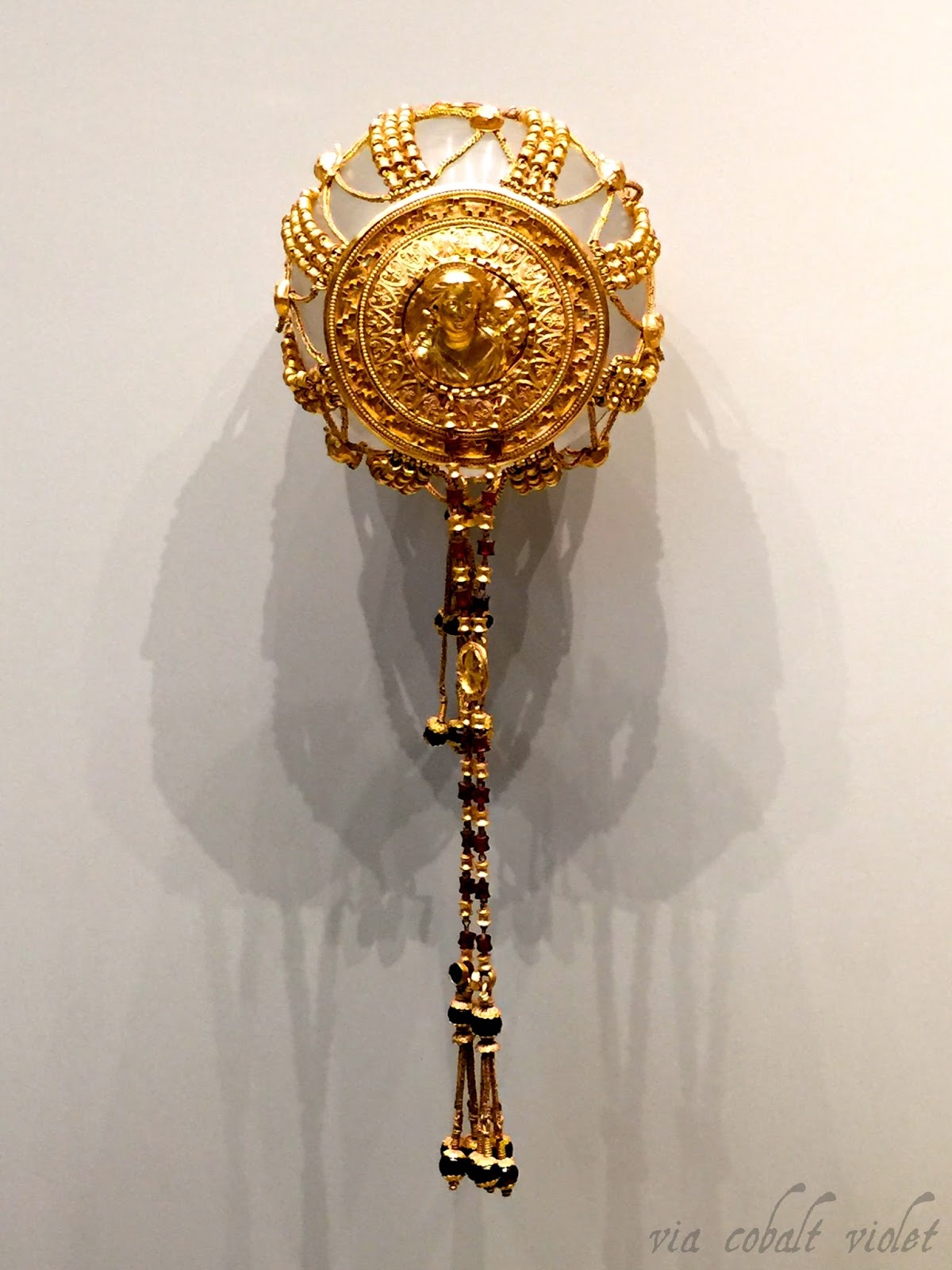

Earring with Nike Pendants
Greek, 225-175 B.C.
Gold and glass


... and going waaaaay back here!
Pregnant Female Figure
Early Cycladic, 2700-2300 B.C.
Marble


Harp Player
Early Cycladic, 2700-2300 B.C.
Marble
(Only one of a dozen known sculptures of its kind.)


They were selling these little olive trees ... 


Wall Fragment with a Peacock
Roman, about A.D. 70
Plaster and pigment
Fresco


In Ancient Rome, Peacocks were brought from India to Rome, where they became exotic pets and were symbols of immortality and wealth.

Below, my sister and her friend Chris.


What you leave behind is not what is engraved in stone monuments,
but what is woven into the lives of others.
~Pericles (Greek circa 495-429 BCE)


No man ever steps in the same river twice,
for it's not the same river, 
and he's not the same Man.
~Heraclitus (circa 535-475 BCE)


That's my sis!


I used to love watching Huell Howser on PBS! Here is his visit to the villa. (He cracks me up. No one is ever more enthusiastic than Huell was!)


for my past posts of the Getty Villa click here and here.

for the official website click here.

Hope you enjoyed the visit! 
blessings and light!

Day by day,
what you choose, 
what you think
and what you do
is who you become.
~Heraclitus (Greek from Ephesus 535-475 BCE)

Tuesday, June 11, 2013

Pizzarium and the Gods ~ A Day at the Musei Vaticani (and my 4 year blog birthday!)

I just remembered, that I recently passed my 4 year blog birthday! I can't believe it! Thank you, to those of you who take the time to come on here and allow me share with you! And, to all of you who share with me ... this amazing blogging world of communing and creativity!

To celebrate ... let's have a slice of pizza!

Yum!
This is my favorite pizza place, in Rome ...


Piazzarium!!!


It's behind metro station Cipro, which is West, and a little North, of the Vatican Museums. So pig out and give yourself plenty of sustenance, so you can make it through the museum. At least, that is what I was telling myself ... and I'm happy to say, it worked. 

They say the place gets very crowded, but I got there a little after 11am on Tuesday morning and it was fine. Oh, and it might be closed on Sunday. I was getting different information, so check before you go.


This, below, is what it looked like, before it was popped it in the oven ... drizzled in olive oil.


And ... what it looked like, out of the oven (below, on the left.) The one on the right was very spicy, but good. The one on the left, was so good, it makes me want to cry, to think of it. 

One of the best things I've ever tasted in my life. So, yes, I recommend Pizzarium. You stand around and eat, and they cut off whatever size you want ... it's delicious. 


I'd been to the Vatican Museums, on my first trip to Rome, in 2008. We didn't have a lot of time, and let me tell you, you need it. It's awful to have to rush by so many masterpieces, so if you can, give yourself the day ... after you have your pizza, that is. 

Hopefully, I have names right for the various gods, goddesses and emperors, in the following photos. It was difficult to keep track and some have very little information about them.

Here, is some beautiful music by Italian/German composer Giovanni Girolamo Kapsperger (1580 -1651.) It's nice to have some Vatican Museum background music ... and don't you just love a lute? :)


The Vatican Museums

Reign 138 - 161 AD


There are so many ancient Roman Statues. I was almost relieved one of the halls was blocked off. There is just no way to see it all, and it gets overwhelming. So, take your time and see what you can.


Statue of Athena


The Octagonal Court


It was raining in this courtyard, which somehow seemed beautiful and appropriate. Especially, with Arno the river god present. You'll see him shortly.


170-180 AD

(Doesn't he look a little melancholy?)


c 40-30 BC


Suicide of Cleopatra
(see the snake on her arm?)


Hall of Animals
 "The Stone Zoo." 
Pope Pius VI (1775-1799 AD) put this group of animals from antiquity together.


Hall of Muses

Statue of Erato, muse of hymns and love songs


Belvedere Torso 
Probably the Greek hero Ajax
1st century B.C.
Athenian sculptor Apollonios
(This ancient statue is said to have been a huge inspiration to artists, including Michelangelo.)


What spirit is so empty and blind,
that it cannot recognize the fact
that the foot is more noble than the shoe,
and skin more beautiful than the garment
with which it is clothed.
~Michelangelo 

Round Hall
The standing figure is The Braschi Antinous
2nd century A.D.

Colossal Head of Jupiter (Zeus) from Otricoli


Statue of a flute player


There is so much to see ... you eventually have to move on from the Ancient Roman world ...


Syria-Palestine from Middle Bronze Age
To the Roman Period 2000 BC - 394 AD


Below, detail from the amazing Gallery of Maps (1536-1586) frescoes, by Dante Ignazio
This one is Liguria
Here is shot of the Hall


Raphael Rooms
Done by Raffaello Sanzio (1483-1520) and his school
Below, looking up at School of Athens


Triumph of Christian Religion
Ceiling of Room of Constantine 
by Tommaso Laureti


(You can see the statue of the Pagan idol has fallen to the ground, broken, below the standing crucifix.)


The Pope who commissioned these frescoes, for his "apartments," was Julius II. He hired a young Raphael for the job, and he's also known for hiring Michelangelo to do the Sistine Chapel. (Anyone see The Agony and the Ecstasy? Pope Julius II will always look a lot like Rex Harrison to me.)

You can see how Pope Julius II, is trying to "out do" his rival, and predecessor, Pope Alexander's "Borgia Apartments." (We'll get to those in another post.)

Carved wood window ...


Some of the frescos were not on view, because they are currently having restorations, like this wall in the Room of Heliodorus.


Details from the "Popes' Apartments," by Raphael and his school

Ceiling of Room of the Segnatura 
Disputation of the Holy Sacrament


These rooms are truly staggering ... you are enveloped in art, so completely and beautifully, it's almost too much to take in!

The ceiling of the Room of Fire, below, is by Perugino (1508.) Raphael refused to paint over it. Good call Mr. Sanzio!


Every beauty 
which is seen here below by persons
of perception 
resemble more than anything else
that celestial source from which we all are come ...
~Michelangelo

Just another ornate hall and ceiling, on the way to more incredible art.


Below, is an amazing Roman mosaic, from antiquity. Yes, ... a mosaic! Amazing, right?

The Three Wreaths Emblema
Hadrianic age, from Hadrian's Villa in Tivoli


Lovely stained glass ... unfortunately, I don't know the artist, and no one else online seems to either, but I read it was a gift from the French to one of the Popes.


A nice break comes, when you get to some work from last century and a half. Even with the subject matter, it was a breath of fresh air, and it felt good to mix things up a little, after days of living with Medieval and Renaissance martyrs.

Il Precursore
Giulio Aristide Sartorio
1927-28


Medardo Rosso
Aetas Aurea, 1886


Messe Matinale
Maurice Denis 
1890


Idea for Crucifixion sculpture, 1954
Henry Moore


Pietà (after Delacroix) 1889
Vincent Van Gogh
(love this!!!)


Here's a little Vatican information and History, courtesy of Rick Steve's ... at 4:13 he goes in the museum.


I found a great blog post about Pizzarium, with a lot more photos and info, so if you want to check it out, click here, and if that's not enough for you, there is another one here.


The true work of art 
is but a shadow of 
the divine perfection.
~Michelangelo 

Blessing and light!!!