and love the people with whom fate brings you together,
but do so with all your heart.
~Marcus Aurelius
Staying with the theme of Antiquity (from my last post) I thought I'd share my most recent pastel.
This photo was taken in 2012, at the Roman Forum. I'd just been on the Palatine hill and the sun had begun to set as I made my way off the hill and through the Forum. They were trying to get everyone out but I managed to make my way into the House of the Vestals. Last time I had been there, there was so much excavation going on, you couldn't really see much, but from the other side of a chain.
The photo I chose for a study was one of those frustrating moments in "point and shoot" photography, where you can get the beautiful sunset sky but everything in the foreground is in silhouette ... or you can photograph the subject matter in front and the sky becomes totally blown out and white!
Solution? Do a painting.
This was mounted, sanded, paper than can take water media. So ... I was covering the surface with water colors, to have a jumping off point for the pastels.
My little setup with my handmade Heilman box, below. It has a little metal easel that sticks into holes drilled into the box, to make it easier for working in plein air (outdoors) ... or in class.
Below, you can see I've started getting the trees, the background Roman structures and sky in, with pastels.
I like doing a pink underpainting in the sky with the watercolor and letting it show through when I go over it with pastel, especially for a painting that's during "magic hour." You can see I've started defining some of the stone of the reflecting pool, as well as some of the other greenery.
Going more into the stonework, and getting the mossy feel, as well as a bit of a reflection ...
And finally, into the statuary ... I kept the ones in the distance softer and more loose.
And here it is! I am going to lighten the lower left corner slightly so it doesn't match so much with the right ... but there you have it!
House of the Vestals Pastel on sanded board 9x12
For my photographic post of that magic hour I spent at the House of the Vestals and Roman Forum click here.
Back on March 30th, I drove to Malibu to meet my sister Penny and her friend Chris, at the Getty Villa. It was a beautiful day to have a little lunch and take a trip back in time!
Fragment of a Female Head
Greek, made in Taras, South Italy
440-430 B.C.
Terracotta
History of the Getty Villa, which is the same short film (12:22) that you can watch when you enter the Villa!
Wreath
Greek, 300-100 B.C.
Gold
"Gold wreaths were often modeled after the floral wreaths given as prizes in athletic contests. Here the leaves and berries imitate those of the laurel, a tree sacred to Apollo, got of prophecy and music. The wreath's fragility suggests that it was not intended to be worn in life but would have served as a funerary offering or a dedication to a deity." (Although, I would totally rock this wreath during the holidays!)
The Secret of change
is to focus all of your energy,
not on fighting the old,
but on building the new.
~Socrates
In the area below, at the end of summer, they put on productions of Greek plays! I've been wanting to go for years. I need to get it together this year!
Mask of a Satyr
Greek, made in the eastern Meditteranean,
300-100 B.C.
Terracotta and pigment
And so hail to you, Dionysos, god of abundant grapes!
Grant that we may come again rejoicing to this season
and from that season onward for many a year.
~Homeric Hymn to Dionysos, about 680 B.C.
Sarcophagus Panel with Medusa and Theater Masks
Roman, A.D. 140-70
Marble
Wall or Ceiling Fragments with a Maenad, and Bacchus and Ariadne (above) Roman, A.D. 1-75 Plaster and pigment
Lovely Venus/Aphrodite!
Altar with Aphrodite and Adonis Greek, made in Taras, South Italy 400-375 B.C. Terracotta and pigment
Statuette of Venus Greek or Roman, 100-1 B.C. Rock Crystal
This little statue is modeled after a large-scale sculpture of Venus crouching to bathe herself, that was made in the Hellenistic Period. That original has not survived but don't you love this crystal version? It was maybe 6 or 7 inches tall, if I remember correctly.
Count each day
as a separate life.
~Seneca (Roman philosopher circa 4 BCE-65 AD)
They have a little interactive area that is set up for the kids. My sister did this little rubbing for my nephew who was at school that day.
He is richest who is content with the least,
for contentment is the wealth of nature.
~Socrates
Love the floors! Yes, those are my Birkenstock clad feet.
Slumbering figure of Eros, next to Hygieia's side. Roman, A.D. 200-250 Marble
Looking down onto the inner peristyle (seen in the first photo) from the second floor.
Head of Emperor Augustus Roman, 25-1 B.C. Marble
Hello, handsome! Augustus was always portrayed as a young man, beardless and idealized. I like to imagine the first Roman Emperor like this, in all his gorgeous studly glory, your basic Roman babe. Sigh.
Bust of Emperor Commodus Roman, A.D. 180-185 Marble
Wine Cup with Revelers Greek, made in Athens, 500-490 B.C. Terracotta Red-figured kylix
The cup above with with drunken young men, holding each other up, cracks me up. The other side has a maenad and a satyr, companions to the wine god Dionysos. Very appropriate!
Looking down from the second floor, you can see the beautiful area below but no water in the pool. (This drought has reminders everywhere!)
True happiness is ... to enjoy the present
without anxious dependence on the future.
~Seneca
Mold-Blown Glass Greek or Roman Glass Bowls between 100 B.C.- A.D. 25
Green Cup with Tendrils Roman, A.D. 1-100
Snake Bracelet
Romano-Egyptian, A.D. 1-100
Gold
Necklace with a Phoenician Pendant of a Bearded Man Etruscan, 525-500 B.C. Gold and glass
Necklace with Relief Pendant Roman, A.D. 200-400 Gold, garnet, emerald, glass, and chalcedony
Bracelet
Roman, A.D. 300-400
Gold, glass, emerald, and sapphire
(so gorgeous!!)
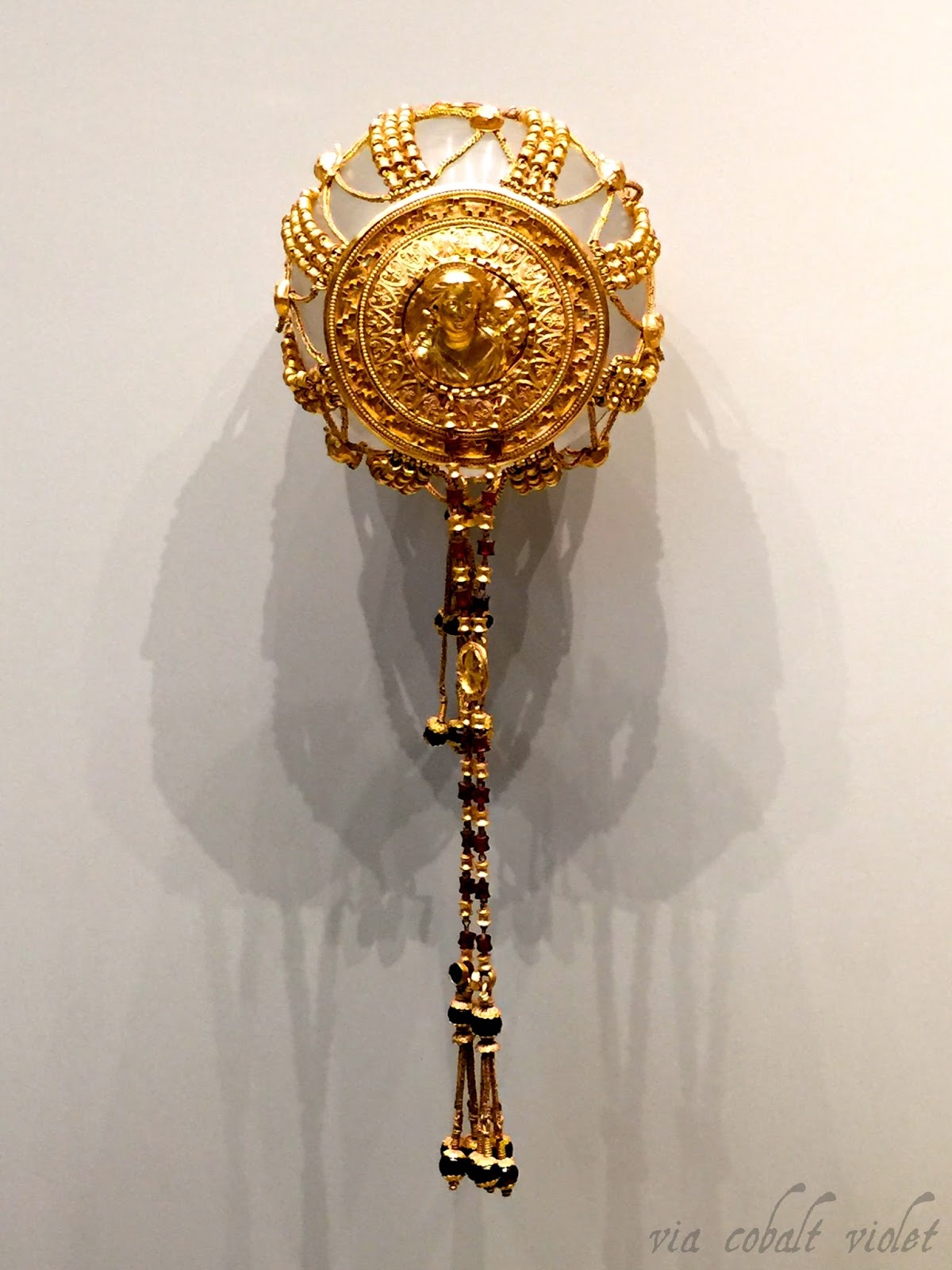
Greek, probably made in Alexandria Egypt, 220-100 B.C. (Need something fabulous to cover your bun?!)
Earring with Nike Pendants Greek, 225-175 B.C. Gold and glass
... and going waaaaay back here!
Pregnant Female Figure Early Cycladic, 2700-2300 B.C. Marble
Harp Player Early Cycladic, 2700-2300 B.C. Marble (Only one of a dozen known sculptures of its kind.)
They were selling these little olive trees ...
Wall Fragment with a Peacock Roman, about A.D. 70 Plaster and pigment Fresco
In Ancient Rome, Peacocks were brought from India to Rome, where they became exotic pets and were symbols of immortality and wealth.
Below, my sister and her friend Chris.
What you leave behind is not what is engraved in stone monuments,
but what is woven into the lives of others.
~Pericles (Greek circa 495-429 BCE)
No man ever steps in the same river twice,
for it's not the same river,
and he's not the same Man.
~Heraclitus (circa 535-475 BCE)
That's my sis!
I used to love watching Huell Howser on PBS! Here is his visit to the villa. (He cracks me up. No one is ever more enthusiastic than Huell was!)
for my past posts of the Getty Villa clickhereand here.